How to read a revision list
The Russian Empire counted the Jews of Medzhybizh household by household. Those lists survive, many of them are free online, and with a little practice anyone can read them. This guide walks through one real book, page by page.
What a revision list is
A revision list (revizskaya skazka) is a census of the taxable population of the Russian Empire. Jews were first counted in the fifth revision (1794–1808); later revisions were taken in 1815–16, 1833–35, 1850 and 1857–59. Each household is written out with the head, his sons and other relatives, their ages, and notes on who had died, moved or been taken into the army since the last count.
From 1827 Jewish communities also had to supply recruits to the army, and the community kept family lists of its men to decide whose turn came next. The 1829 and 1833 "recruitment family lists" (rekrutskiye semeinye spiski) for Letichev district, which includes Medzhybizh, are one of these books, and the one used below.
The book used in this guide
State Archive of Khmelnytskyi Oblast (ДАХмО), fond 226, opis 79, file 4747: recruitment family lists of the Jewish townspeople of Letichev district, 1829 and 1833. 1,216 pages, photographed from microfilm.
- The archive page on Ukrainian Wikisource: Архів:ДАХмО/226/79/4747
- The whole book as one PDF on Wikimedia Commons: open the PDF (a large file; give it a minute to load)
Other files from the same archive are listed the same way. Try the address uk.wikisource.org/wiki/Архів:ДАХмО/226/79/ followed by the file number.
Step by step
- Find your family in the index first. Search the JewishGen Ukraine database for the surname and town. Spell it loosely: the clerks wrote names by ear, so Glik may be Gelik, Gluk or Glikman. A result gives the archive file, the page numbers (for example "722(back)–723") and the household number.
- Open the PDF and jump near the page. The PDF's page counter is not the archive's page number. The archive numbered its leaves by hand, in the top right corner of the right-hand page. Go to a PDF page, read the corner, and move forward or back.
- Understand "back". The archive numbers each leaf once. "722" is the front of leaf 722; "722(back)" is the reverse side, the left-hand page you see when you turn over. One household is written across a spread: names on the left (722 back), ages and remarks on the right (723).
- Count the jump. In this book one archive leaf is about two PDF pages. Example: archive page 723 is PDF page 1129; the alphabetical index at archive pages 739–740 is PDF pages 1159–1161. Different parts of a big file can drift, so always check the corner number.
- Zoom in. The pictures are microfilm negatives: white writing on black. The clerk's hand is clear once it is large. A phone photo of the screen works well for reading later.
Reading one household
Here is household 45 on archive page 722(back), with its ages and remarks on page 723.
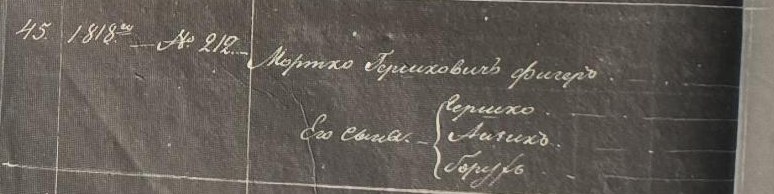
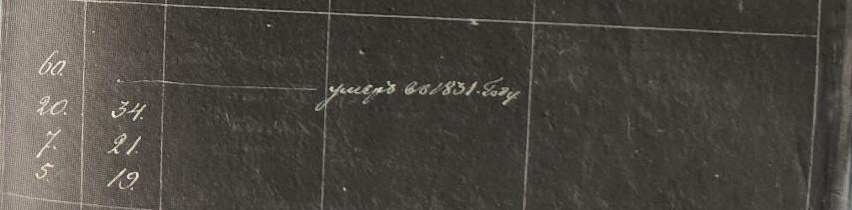
| Column | What it says here | What it means |
|---|---|---|
| Number | 45 | The household's number in this list. The alphabetical index points to this number. |
| Earlier list | 1818 г. № 212 | Where the family was counted before: household 212 of the 1818 list. Follow this number back to the older book. |
| Names | Мортко Гершковичъ Фигеръ | Mortko, son of Gershko, Figer. The middle name is the father's name: -ovich / -evich means "son of". |
| Его сыны: Гершко, …, Борухъ | "His sons": Gershko, a second son, Borukh. A curly bracket groups them. | |
| Age at the earlier list | 60; 20; 7; 5 | Ages when last counted (here in 1818). |
| Age now | —; 34; 21; 19 | Ages in this list. A dash means the man is no longer counted. |
| Remarks | умеръ въ 1831 году | "Died in 1831", written against the father's line. |
Using the alphabetical index
At the end of each list is an index of families, by surname, with the household number.
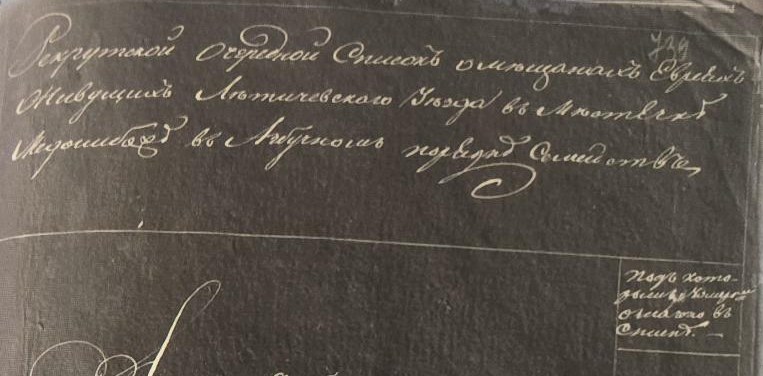
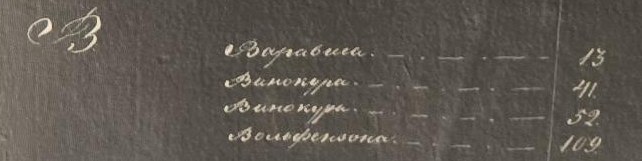

- Surnames in the index end in -a. The clerk wrote "of Vinokur" (Винокура), so drop the final -a to get the name: Винокура = Vinokur, Варавина = Varavin.
- Letters follow the Russian alphabet: А, Б, В, Г, Д, Е, Ж, З, И, К, Л, М…
- A big file holds several lists (by town, and by class: townspeople, craftsmen, merchants), and each list starts again at number 1 with its own index. Make sure the index and the household are from the same list.
Words you will meet
| Written | Say | Meaning |
|---|---|---|
| сынъ / его сыны | syn / ego syny | son / his sons |
| братъ | brat | brother |
| племянникъ | plemyannik | nephew |
| внукъ | vnuk | grandson |
| пасынокъ | pasynok | stepson |
| воспитанникъ | vospitannik | foster son, ward |
| зять | zyat | son-in-law |
| умеръ въ … году | umer v … godu | died in the year … |
| взятъ въ рекруты | vzyat v rekruty | taken as a recruit into the army |
| новорожденъ | novorozhden | newborn (born since the last count) |
| по особой сказкѣ | po osoboy skazke | "by a separate return": the family was entered from its own declaration |
| отлучился | otluchilsya | absent, left the town |
| перечисленъ | perechislen | transferred to another town's list |
| года / г. / № | goda / g. / nomer | of the year / year / number |
- Old letters. A hard sign ъ at the end of a word is silent (Борухъ = Borukh). ѣ reads as e, and і as i.
- Everyday forms of names. Clerks wrote the Yiddish forms people used: Gershko or Girsh = Hirsh (Tzvi); Leyba = Leib (Aryeh); Volf = Wolf (Ze'ev); Srul = Yisrael; Moshko = Moshe; Itsko = Yitzhak; Yudko = Yehuda; Mortko = Mordechai; Abramko or Avrum = Avraham; Leyzor or Luzer = Eliezer. The JewishGen Given Names database lists the variants.
Why someone may be missing
- Recruitment lists count men and boys. Some revisions list women on separate pages; some lists omit them.
- Lists were often copied forward from an earlier count, so a boy born after that count may not appear until the next revision.
- Families moved between lists (townspeople, craftsmen, merchants) and between towns. Check the other lists in the same file, and the remarks column.
- Records burned. A fire at the Kamianets-Podilskyi archive in 2003 destroyed part of this record group. A gap may be a loss, not an absence.
Write down where you found it
Note everything another person would need to find the same line again:
ДАХмО (State Archive of Khmelnytskyi Oblast) 226-79-4747, 1833 recruitment family list of the Jewish townspeople of Medzhibozh, household 45, archive pp. 722(back)–723 (PDF pp. 1128–1129), Ukrainian Wikisource, viewed [date].
Getting help
- Post a picture of a hard entry to JewishGen ViewMate; volunteers translate Russian and Hebrew handwriting.
- The JewishGen Ukraine Research Division indexes these records and can say what has been transcribed.
- Next: Find your Medzhybizh family and How to read a Jewish gravestone.
With thanks to the JewishGen Ukraine Research Division, who pointed to this copy of the book.
Sources
- Ukrainian Wikisource: ДАХмО 226-79-4747, 1829 and 1833 recruitment lists of the Jewish townspeople of Letichev district
- Wikimedia Commons: the scanned book (PDF)
- Wikipedia: Revision list (the revisions and their years)
- JewishGen Ukraine Research Division: What are Russian revision lists?
- JewishGen InfoFile: Jews and military service in the Russian Empire (the 1827 statute)
- JewishGen Ukraine database
- Avotaynu, "Nu? What's New?" (13 April 2003): the Kamenets-Podolsk archive fire
Images: State Archive of Khmelnytskyi Oblast (ДАХмО), fond 226, opis 79, file 4747, via Wikimedia Commons. The transcriptions, translations and explanations on this page are © 2026 Michael Howard.